

Artificial intelligence is changing how people write at home, at school, and at work. Students, professionals, researchers, businesses, and everyday users are finding different ways to include these tools in their writing.
Understanding AI writing starts with knowing what these tools do, where they are useful, and when their output needs closer attention. This article explains how AI writing works, how it is used in everyday life and professional settings, and what to consider regarding accuracy, privacy, authorship, and U.S. copyright rules.
If you’re looking for a tool to help with blog posts, emails, website copy, or social media content, check out our article on the best AI writing app to explore its features, pricing, and potential uses.
What Is AI?
What Does Artificial Intelligence Mean?
Artificial intelligence, usually called AI, refers to computer systems designed to perform tasks that commonly involve human abilities. These tasks include recognizing patterns, processing language, analyzing information, making predictions, and generating responses.
AI systems serve different purposes. Some analyze images, others help identify patterns in data, and some work with written or spoken language.
Generative AI creates new content, such as text, images, audio, or video, in response to instructions or other inputs. AI writing tools use this technology to help people create and revise written material.
AI does not understand the world through personal experiences in the way a human does. It produces responses through computational processes and patterns learned during training.
What Is AI Writing?
AI writing uses artificial intelligence to generate, edit, summarize, translate, or improve text. A person provides an instruction, a question, or some source material, and the tool produces a response based on the information available to it.
Tools such as ChatGPT, Grammarly, Microsoft Copilot, Google Gemini, and Claude offer different forms of writing assistance. Their features vary, but they can help with drafting, editing, brainstorming, and summarizing.
How Is AI Used for Writing?
Emails, Messages, and Everyday Communication
AI writing tools can help people draft emails, reply to messages, write requests, and adjust a conversation’s tone. AI can also help shorten long messages or turn scattered notes into a readable explanation.
Stories, Creative Writing, and Personal Projects
Writers can use AI to brainstorm story ideas, develop fictional characters, explore possible endings, or experiment with dialogue. It can also help with speeches, personal statements, scripts, invitations, and other creative projects.
Documents, Summaries, and Reports
AI can help organize meeting notes, create report outlines, summarize lengthy documents, and turn rough notes into a more readable format.
Editing, Rewriting, and Translation
AI writing assistants can suggest corrections to spelling, grammar, punctuation, sentence structure, and word choice. They can also rewrite a paragraph for a different audience or explain a complicated passage in simpler language.
Translation is another common use. AI can help people understand foreign-language material, draft multilingual communications, or find alternative ways to express an idea.
Who Uses AI for Writing?
| Education | Business | Marketing |
| Healthcare | Journalism | Advertising |
| Blogging | Copywriting | Journalism |
| Entertainment | Literature | Communication |
| Recruitment | Technology | Programming |
| Government | Legal | Research |
| Publishing | Ecommerce | Finance |
| Banking | Customer Service | Sales |
| Human Resources | Healthcare | Science |
| Translation | Editing | Social Media |
| SEO | Storytelling | |
| Screenwriting | Gaming | Travel |
| Real Estate | Insurance | Nonprofits |
| Administration | Documentation | Productivity |
| Personal | Relationships | Religion |
| Politics | Agriculture | Hospitality |
| Consulting | Training |
AI Writing in Marketing
Advertising and Promotional Content
Businesses can use AI to draft advertising copy, product descriptions, promotional emails, social media captions, and campaign ideas. It can also suggest different ways to present a product or service.
Marketing Research and Content Planning
Marketing teams can use AI to organize existing customer feedback, summarize research findings, brainstorm topics, and prepare initial content plans. It can help arrange information into themes and suggest questions worth investigating.
Benefits and Limitations of AI in Marketing
AI can help marketing teams prepare drafts and explore different messaging options. It can also make it easier to adapt an established message for different formats.
The limitation is that generated content may sound generic or fail to reflect a brand’s actual voice. If several businesses rely on similar prompts, their content may become repetitive.
Human review helps ensure that marketing material is accurate, relevant to the intended audience, and consistent with the business’s identity. The final message should reflect genuine knowledge of the product and the people it is meant to reach.
What Are the Benefits of AI Writing?
Saving Time on Routine Tasks
AI can reduce the effort required to begin a writing task. It can suggest an outline, produce an initial draft, organize notes, or summarize material that would otherwise take time to arrange manually.
This can be helpful when the writer already understands the subject but needs help with structure or wording. Instead of starting with a blank page, the person can review a draft and focus on improving it.
Making Writing Clearer
AI can suggest shorter sentences, explain unfamiliar words, identify awkward phrasing, and offer alternatives for unclear passages. These features can help writers communicate with readers who have different levels of knowledge.
Helping People Explore Ideas
AI can suggest topics, examples, outlines, and different approaches to a writing task. This can help when a writer needs a starting point or wants to compare several options.
It may also help people who find spelling, grammar, or language expression difficult.
What Are the Risks and Limitations of AI Writing?
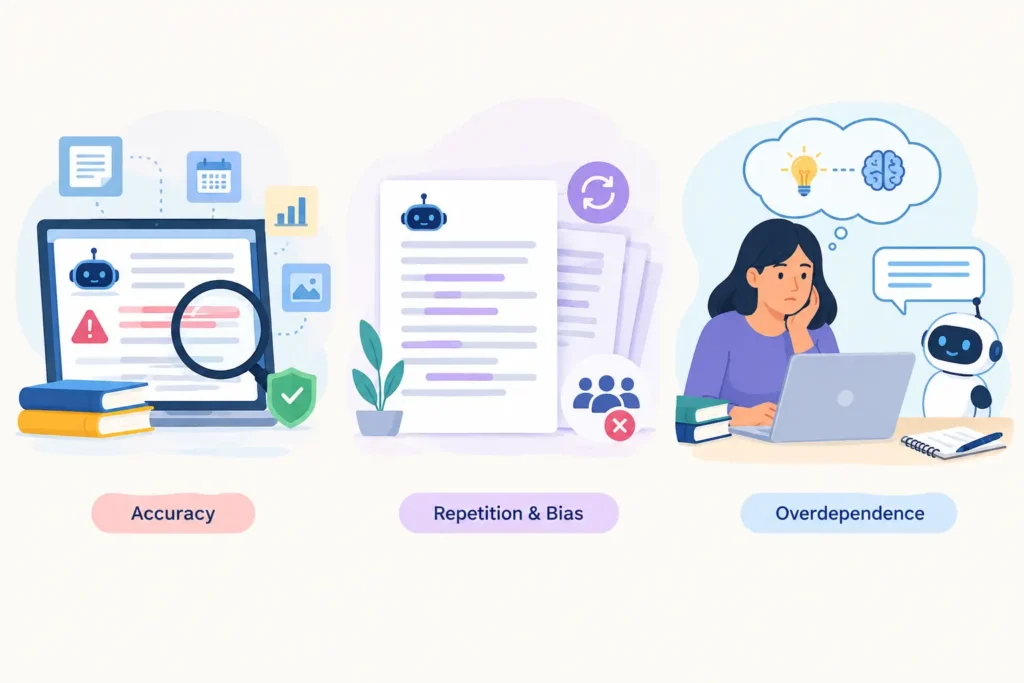
Incorrect Information and Fabricated Details
AI-generated text can include factual errors, invented details, misleading explanations, or references that don’t exist. These mistakes can appear in responses that sound confident and well-written.
In AI research, an inaccurate or fabricated response is often called a hallucination. The term describes an output that presents unsupported or incorrect information as though it were true.
Check names, dates, statistics, quotations, references, and technical claims against reliable sources. In health, legal, financial, and other high-impact areas, seek appropriate professional guidance when necessary.
Repetitive Writing, Bias, and Weak Originality
AI may repeat familiar expressions, rely on predictable examples, or produce paragraphs that sound similar to one another. Its output can also reflect biases in its training data or in how a question is framed.
A draft may be grammatically strong but still lack personal observation, a clear argument, or subject-specific details.
Overdependence on AI
Using AI for every stage of writing can reduce opportunities to practice developing ideas, building arguments, and making independent decisions.
This matters in education because writing is part of the learning process. It also matters at work: someone who approves a document without understanding it may miss important errors or make a poor decision.
How Is AI Changing Education and Academic Writing?
AI in Schools and Universities
AI tools can help students review concepts, develop outlines, practice writing, and identify unclear sentences. Teachers may use them to prepare examples, lesson materials, and explanations.
The key question is whether AI supports the learning objective. If an assignment is designed to assess a student’s independent reasoning or writing ability, having AI produce the answer may defeat its purpose.
Northern Illinois University’s guidance on AI for writing recommends using AI at appropriate stages of the writing process while keeping the student involved and critically evaluating the output.
AI-Generated Essays and Academic Integrity
Academic integrity means following the rules and expectations for honest academic work. AI raises questions about acceptable assistance, authorship, and when students must disclose their use of a tool.
One instructor may permit AI-assisted brainstorming but prohibit generated essays. Another may design an assignment that specifically asks students to evaluate AI output. The rules depend on the institution and the task.
Students should read assignment instructions and ask for clarification when necessary. They should also verify references and claims rather than assume that generated material is accurate.
AI Writing Policies in Education
Educational institutions may set policies covering AI use in coursework, examinations, research, and other academic activities. These policies can explain when assistance is allowed, whether disclosure is required, and how violations are handled.
AI detectors may be used as one part of an academic review, but their results need careful interpretation. Turnitin states that its AI writing detection can misidentify human-written, AI-generated, and AI-paraphrased text. It advises that the result should not be the sole basis for adverse action against a student.
The relevant policy should guide the decision, with human judgment and other evidence considered where appropriate.
AI Writing in Research and Healthcare
Research Papers and Scientific Publications
Researchers may use AI to improve language, organize notes, summarize material, or prepare early drafts. This can help with communication, especially when a researcher is writing in a second language.
However, scientific writing depends on accurate evidence and faithful reporting. AI can misstate findings, invent citations, or introduce conclusions that the research does not support.
Researchers should check every important claim against sources and confirm that the final paper accurately describes the methods, data, and conclusions. They should also follow the disclosure rules of their institution and the journal to which they submit their work.
Medical Writing and Documentation
AI may help organize clinical notes, summarize information, draft patient-facing explanations, or reduce some administrative writing tasks.
Medical content requires particular care because errors can affect patient understanding and care. A generated summary could omit an important detail or make an uncertain statement sound definitive.
Qualified professionals should review medical material before using it for clinical decisions or presenting it as authoritative guidance. Patient information must also be handled in accordance with applicable privacy rules and organizational policies.
Accuracy and Professional Responsibility
In research and healthcare, good wording is not enough. The content must be accurate, supported by evidence, and appropriate for its intended use.
Professionals remain responsible for the documents they approve and share. AI can assist with writing, but it cannot replace the need to verify evidence, protect confidential information, and apply professional judgment.
Can You Tell Whether Text Was Written by AI?
What Are AI Writing Detectors?
AI writing detectors are tools that estimate whether text was AI-generated or modified. They analyze features of a passage and produce a result based on their detection methods.
Are AI Detectors Always Accurate?
No. AI detectors can incorrectly flag human-written text or fail to identify AI-generated material. Performance can vary by detector, text, language, and editing level.
This matters especially when the result could affect a student’s academic standing or a writer’s reputation. A score alone cannot establish that someone violated a rule.
A fair assessment should consider the relevant policy and other available evidence. Where necessary, reviewers can examine drafts, notes, revision history, and the writer’s understanding of the work.
What Does Authentic Writing Mean?
Authenticity is not determined only by whether AI was involved. A person may write an original article and use a tool to correct punctuation. Another person may submit generated text without checking it or contributing meaningfully to its development.
The distinction depends on the process, the person’s contribution, the final content’s accuracy, and the setting’s expectations.
AI Writing, Privacy, and Security
What Happens to Information Shared With AI Tools?
When a user enters information into an AI service, the system processes it to generate a response. How the service stores or uses the information afterward depends on the service, its terms, its settings, and the account type.
Should You Put Confidential Information Into an AI Tool?
Avoid entering private correspondence, customer records, medical information, unpublished research, company documents, and personal identifiers.
Before entering such material, check whether you have permission to share it and whether the service meets the applicable security and privacy requirements. Remove unnecessary identifying details when possible.
Misleading Content and Misuse
AI can generate deceptive messages, fabricated statements, and text that impersonates another person. Fluent writing does not prove that a message is genuine.
Be cautious when a message requests money, account access, personal information, or urgent action. When something seems unusual, verify the sender and important claims through a trusted channel.
AI-generated content is not automatically deceptive. Its purpose, accuracy, and context determine how to evaluate it.
What Are the U.S. Rules for AI Writing and Copyright?
U.S. Government Policies on AI
In the United States, AI-related rules and guidance cover different issues, including privacy, consumer protection, intellectual property, and automated systems. Federal agencies, state governments, and institutions may address different parts of the subject.
No single rule covers every use of AI writing in every setting. Requirements depend on the activity, the organization, and the applicable law or policy.
The Generative AI Profile and the AI Risk Management Framework, both created by the National Institute of Standards and Technology (NIST), are meant to help organizations handle the challenges and risks that come with artificial intelligence. These materials serve as guidance on best practices for AI risk management, but adopting them is a matter of choice rather than a universal requirement.
Can You Copyright AI-Generated Writing in the United States?
Copyright protection for AI-assisted work depends on the human contribution and the facts of the particular case.
The U.S. Copyright Office’s January 2025 report on copyrightability explains that AI assistance does not automatically prevent copyright protection. Human-authored expression, creative selection or arrangement, and meaningful modifications can matter. Simply providing prompts, by itself, is not enough to establish authorship of the resulting AI-generated material.
This area of law is nuanced. Anyone making an important publishing or commercial decision should consult the U.S. Copyright Office’s AI resources and seek qualified legal advice when needed.
Do You Have to Disclose AI Writing?
Disclosure requirements vary. A university, employer, publisher, journal, or platform may have its own rules about when and how to acknowledge AI use.
How Can You Use AI for Writing Responsibly?
Give Clear Instructions
Explain the task, the intended reader, the purpose, and any limits the tool should follow. If you need a short, friendly email, say so. If you want a plain-language explanation for beginners, provide that context.
Clear instructions can improve the response’s relevance.
Check the Information
Verify factual claims against reliable sources, especially when the content involves legal requirements, health, finance, research, or technical subjects. Check that links and references exist and support the statements attached to them.
Revise the Draft
Read the output as a writer, not just as someone checking for spelling errors. Remove unnecessary sentences, correct errors, add missing context, and make sure the language fits the intended audience.
Include personal experience only when it is genuine. Add examples only when they are accurate and relevant.
Protect Private Information
Review the tool’s data practices before sharing confidential or sensitive material. Follow workplace, educational, and professional rules, and use approved systems when required.
Follow the Rules of the Task
Before using AI for coursework, research, client work, or publication, check whether assistance is allowed and whether you must disclose it.
What Is the Future of AI Writing?
Writing Tools Will Continue to Change
AI writing tools are being incorporated into word processors, communication platforms, research products, and other software. These integrations may make it easier to move between drafting, editing, summarizing, and organizing information.
How helpful these features are will depend on their reliability, how well they protect your privacy, and how effectively they meet your needs. Even with new capabilities, you should still review any critical content.
Authorship and Trust Will Remain Important
As AI becomes more common, schools, employers, publishers, and readers will keep asking questions about originality, disclosure, and responsibility.
Frequently Asked Questions About AI Writing
What is AI writing in simple terms?
AI writing refers to using artificial intelligence to generate, revise, summarize, translate, or enhance written content.
What are AI writing tools used for?
AI writing tools can help draft emails, brainstorm ideas, outline articles, summarize documents, correct grammar, translate text, prepare reports, and develop creative projects.
Is AI writing free?
Some AI writing tools offer free access with limits on features, usage, or availability. Others require a paid subscription for additional capabilities. Pricing and limits change, so check the provider’s current plan details before choosing a tool.
Can Google tell if AI wrote content?
No reliable basis exists to assume that a particular phrase or writing style proves AI authorship. Google’s published guidance focuses on helpful, reliable, people-first content and warns against producing content primarily to manipulate rankings. The practical priority is to provide original value, factual accuracy, and a satisfying experience for readers.
Does AI-generated content rank in Google?
AI-assisted content can be eligible to appear in Google Search, but using AI does not guarantee rankings. Content created primarily to manipulate search results may violate Google’s spam policies. What matters is whether the page is useful, accurate, original, and created for people rather than to attract search traffic.
Can AI-written content appear in ChatGPT and other AI search tools?
AI-powered search services may discover and cite public websites, but inclusion is not guaranteed. Publishers should make sure their pages can be crawled where appropriate, provide clear and useful information, and maintain accurate content. For ChatGPT Search, website owners can review OpenAI’s publisher and developer guidance.
Is AI writing safe to use?
AI writing can be useful, but safety depends on the task and the information shared. Check factual claims, protect sensitive data, follow applicable rules, and seek qualified review when the content could affect important decisions.
Will AI replace human writers?
AI can automate or assist with some writing tasks, but it does not remove the need for human judgment, subject knowledge, personal experience, and responsibility. Its impact will vary by job and industry. Writers can use AI as one tool in their process while continuing to develop their own skills.
Conclusion
AI writing tools can help people draft messages, organize information, improve language, explore ideas, and prepare content for many different purposes. They are useful in everyday communication, education, business, marketing, research, and creative work.
Their limitations matter just as much as their capabilities. Generated text can contain errors, omit context, expose sensitive information, or fail to meet a task’s requirements. Copyright, disclosure, and authorship also depend on the circumstances.
The most reliable approach is to use AI where it helps, check what it produces, protect private information, and remain responsible for the final work. Writing is not just producing sentences. It is also the process of deciding what is true, what matters, and what another person needs to understand.

Digital Marketer, SEO Enthusiast
Authored by Abu Talha, who founded Sembron.com and enjoys diving into the world of SEO, software, and AI technologies.